
Together an Active Future have been working alongside The National Evaluation and Learning Partnership (NELP) and Sport England to support learning and evaluation of whole systems and placed-based approaches, enhancing understanding of how to address inequalities in physical activity.
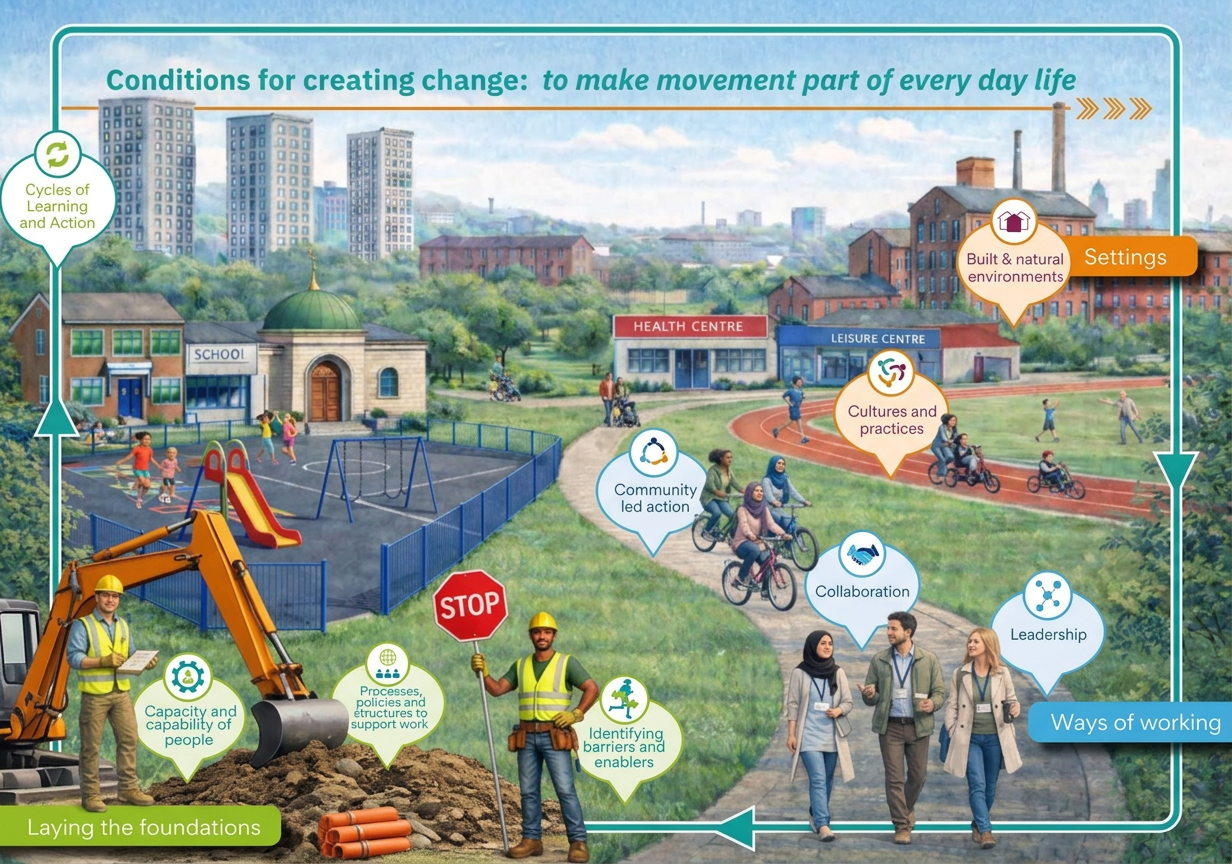
NELP have identified nine ‘conditions’ that may be necessary for place-based approaches to address inequalities. Each condition is itself made up of a range of activities and ways of working that combine to contribute to positive change. NELP’s understanding of these ‘conditions’ has derived from explanations of change reflected in the process evaluations submitted by Place Partnerships nationwide, including TaAF.
The System Maturity Matrix provides descriptors of different levels of maturity in relation to these nine conditions and this has helped actors reflect on the extent to which conditions are present in the place-based system in which they are working. If you’d like to learn more about the System Maturity Conditions for Place-based Systemic Approaches to Physical Activity Inequalities click here.
Following analysis based on these conditions, TaAF is proud to be regarded as a ‘mature system partner’. In addition, each of our network leads have received feedback for their individual areas.
“Thanks again for the time and effort that you [TaAF] and your partners and colleagues have put into responding to the NELP CCA surveys and moderation process over the last few months”, NELP comment.
The NELP moderation process is extremely thorough and designed to ensure they have consistency of interpretation of the system maturity levels across different places. To achieve this our NELP lead Rachael McHugh, has participated in a series of meetings to discuss the individual conditions with other Place Partners across the country (click here if you’d like to watch the recordings), attended moderation meetings and provided further information where required.
TaAF developed a helpful set of questions to guide colleagues through the NELP Systems Maturity Matrix Survey — check them out here.
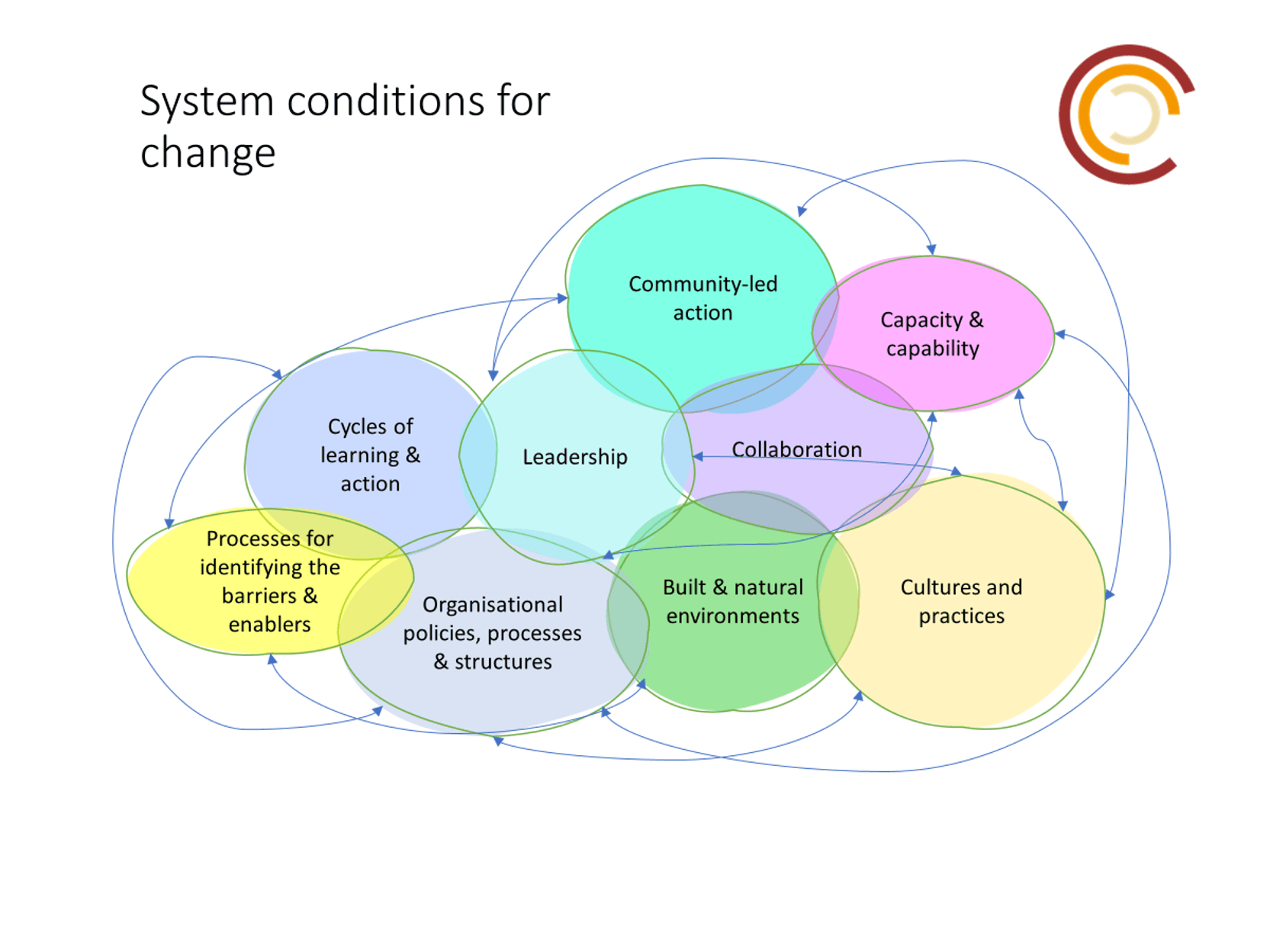
In this blog we share the nine ‘Conditions for Change’ against which we TaAF, have been measured:
The conditions for change and their definitions are:
Identifying the barriers and enablers of physical activity
There is process for developing a deep understanding and (shared) knowledge of what supports and/or prevents people being physically active, within the local context.
Actions which are based on a deep understanding of the barriers and enablers of physical activity are more likely to lead to effective and sustainable outcomes. Sharing knowledge of barriers and enablers can help drive a common purpose and common strategy – increasing likelihood of collective impact on what matters most.
Organisational policies, processes, and structures enable place-based working
Policies, administrative systems, structures and processes effectively enable and encourage place-based ways of working to address inequalities.
The ways in which organisations work together, and how they engage with communities, are often shaped by their organisational structures, policies, and practices. This includes the ways in which information is captured, used, and shared, or not. For example, how team structures align with communities and partners, the ways in which success is measured, and who is able to make or influence decisions. These processes affect how we view and relate to people and communities, with real impacts in people’s lives, but they often go unnoticed or taken for granted. Effective Place-based working requires us to proactively identify, challenge and change these systemic factors.
Capacity and capability across the workforce, volunteers and in communities

Action to develop capacity and capability across the workforce, volunteers, and communities to work in a place-based systemic approach to enable physical activity.
Specific skill sets and attributes are needed to for this type of responsive working. (E.g. to identify barriers and enablers, distribute leadership and collaborate). These skill sets and attributes are not inherently present amongst the existing workforce, volunteers, and communities. Alternative skill sets and attributes can actively block progress. Strategies for building capacity and capability, tailored to the local context, can increase competence and motivation to act in ways which are conducive to tackling physical activity inequalities.
Collaboration

There is productive partnership working around a common purpose.
Working with different organisations can help to drive innovative physical activity policy and practice by drawing on different skill sets, and increase impact by reducing duplication and/or pooling resources. Working with different organisations can support shared problem solving and unravel contradictions in local systems which prevent physical activity or contribute to inequalities.
Leadership
Policymakers, workforce, volunteers and residents act together to build on strengths and remove barriers for tackling physical activity inequalities.
When decision making, resources and initiatives are less centralised, people in all roles can contribute towards enabling active lives. Everyone’s contribution is equally valued. Established leaders can use their power to legitimise physical activity (alone or as a recognised aspect of wellbeing/thriving/prevention), challenge prevailing views and structures which create inequalities, and prioritise whole system and place-based ways of working.
Individuals across multiple layers of society, including people who are inactive, can shape decisions about what works to enable physical activity; this can lead to better strategies and outcomes.
Community Led Action
Action is shaped and led by communities and supported by community-focused strategies.
When community members engage at their pace and in spaces that they can shape, they are more likely to engage and collaborate. This approach often leads to more appropriate actions that enable physical activity. Where there is community-led action on wider inequalities then the this may contribute to a sense of ownership and control over their own lives.
Cultures and practices that enable physical activity

There is a culturally inclusive social environment for physical activity which enables people to move more in ways that suit them.
How physically active we are is shaped by the cultural contexts of our lives; what behaviours we intuitively feel are normal and expected for ‘people like us’. This may vary with the contexts of our lives, whether we are at work or school, with family or engaging with wider interest groups and communities around us.
People may not relate to those they see engaging in physical activity, due to identity or culturally based differences, including gender, (dis) ability, social class, sexual orientation or ethnicity. These feelings maybe reinforced by practical barriers, such as clothing or equipment needed, or past experiences of exclusion, humiliation or shame. By working respectfully and constructively with people within less active communities and groups, we may find ways to enable changes in perceptions, beliefs, practices and values.
Built & natural environments that enable physical activity
Local natural and built environments are attractive, accessible and safe, encouraging movement and physical activity.
Actual and perceived characteristics of the natural and built environment affect physical activity behaviours. Accessible, appropriate, affordable and safe environments are unequally distributed in society, but appropriate design and/or management of such spaces can help to address this. This may include access to blue and green spaces, urban planning, and workplace design.
Cycles of learning and action

There are appropriate methods in place to learn from experience and, over time, improve place-based working to address physical inactivity.
Physical inactivity inequalities are the result of multiple interacting influences, which makes it difficult to understand cause and effect in simple terms. We have to accept that some degree of uncertainty and partial knowledge.
We can, however, build better understanding of how particular actions and ideas work and the contexts in which they typically do or do not. Gathering and apply this information can provide ‘decision support’ to guide future actions in context.
These conditions represent our current understanding, based on existing theory and emerging evidence; however, they may be refined as our understanding of systemic transformation grows.
The above text has been extracted from NELP’s ‘Overview of the conceptual model and conditions for tackling inequalities in physical activity‘. To read the document, click here.
We’ve created printable graphics of each NELP condition and its description, so you can easily display them in your workplace. Click the above titles to download the individual files, or click here to access all nine in one PDF document.